
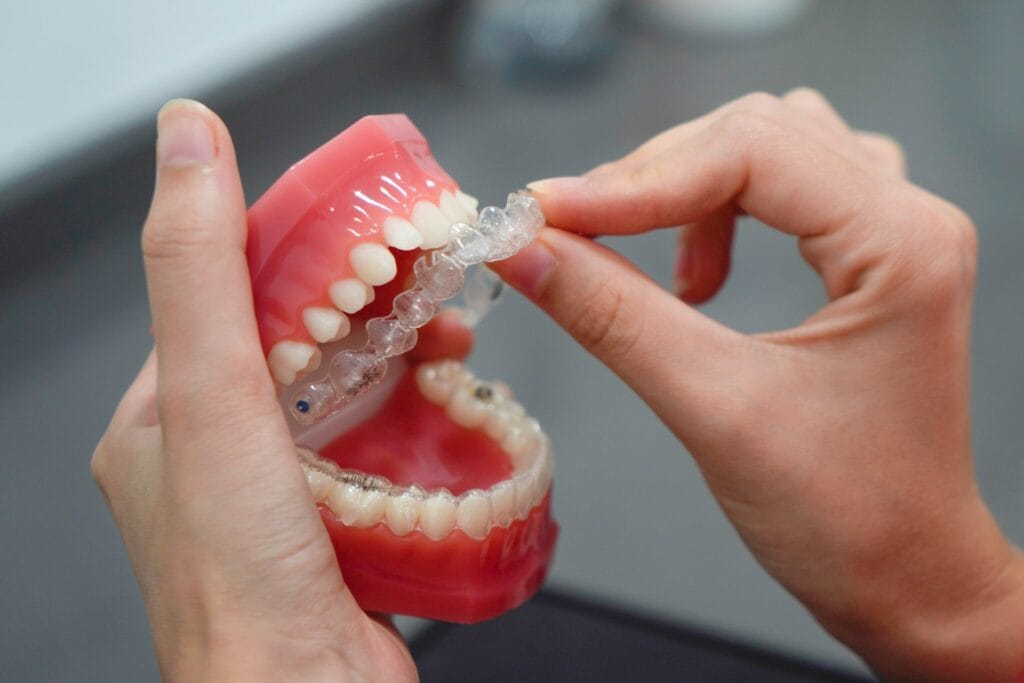
A lot of people call our office and ask for Invisalign the way you’d ask for a Kleenex. It’s the name everyone knows. What we actually use at Mooring Dental is SureSmile, and the first question we get is usually some version of “is that the same thing?” The second question, often from a parent, is whether their teen should just get braces instead. Here’s how we answer both when you’re sitting in the chair.
The short answer
SureSmile and Invisalign are the same kind of treatment: clear, removable trays made from a 3D scan. The differences are the manufacturer, the price and how the trays are trimmed, not the result. Braces still win for severe bites and for anyone who won’t wear trays 22 hours a day.
First, what clear aligners are
SureSmile and Invisalign are both clear aligner systems. The process is the same with either one. We take a digital 3D scan of your teeth, no goopy impressions. A plan is built on the computer showing where each tooth needs to move and in what order. Then a series of thin, clear, custom-made trays is produced. You wear each set for about a week or two, and each one nudges your teeth a little further along the plan. The trays come out to eat, drink anything other than water, and brush. They go back in for the rest of the day, which means 20 to 22 hours of wear.
For most people a full course takes 12 to 18 months, with shorter treatments for minor crowding and longer ones for bigger bite corrections. You come in every so often for a check and to pick up your next batch of trays.
SureSmile vs. Invisalign: what’s actually different
Less than the marketing suggests. Both are made from medical-grade clear plastic. Both are designed from a 3D scan by the dentist and refined by the manufacturer’s lab. Both use small tooth-colored attachments when a tooth needs extra grip to rotate or move. Both are nearly invisible from a few feet away. The results, for the kinds of cases a general dentist treats, are equivalent.
The real differences are these:
- Who makes them. Invisalign is made by Align Technology. SureSmile is made by Dentsply Sirona, the same company behind the CEREC system we use for same-day crowns.
- Price. Invisalign carries a brand premium. SureSmile is generally priced lower for a comparable case, which is part of why we chose it. You’re paying for the treatment, not the name.
- Trimming. SureSmile trays are typically cut in a straight line just above the gums, while Invisalign trays are scalloped along the gum line. Some patients find one more comfortable than the other. In practice most people stop noticing either within a week.
If you came in asking for Invisalign and we put you in SureSmile, you’d get the same kind of plan, the same kind of trays and the same kind of result. If you have a strong preference for the Invisalign brand specifically, that’s a fair thing to want, and we’d rather you know up front what we use.
Side by side: SureSmile, Invisalign and braces
| SureSmile | Invisalign | Braces | |
|---|---|---|---|
| How it looks | Clear, nearly invisible | Clear, nearly invisible | Visible brackets and wires |
| Removable | Yes, 20 to 22 hours of wear | Yes, 20 to 22 hours of wear | No, fixed on |
| Food rules | None, trays come out | None, trays come out | No hard, sticky or chewy foods |
| Brushing and flossing | Normal routine | Normal routine | Harder, around brackets |
| Best for | Crowding, spacing, mild to moderate bites | Crowding, spacing, mild to moderate bites | Severe bites, big movements, younger teens |
| Typical time | 12 to 18 months | 12 to 18 months | 18 to 24 months |
| Depends on you wearing it | Yes | Yes | No |
| Price | Generally lower | Brand premium | Varies, can be less for complex cases |
Aligners vs. braces: who should pick which

This is where the honest conversation happens. Braces are still the right choice for some people, and we’ll say so.
Clear aligners tend to be the better fit when:
- The problem is crowding, spacing, or a mild to moderate bite issue. That covers most adults and a lot of teens.
- Appearance during treatment matters. Adults in client-facing jobs, teens who are self-conscious, anyone with a wedding or a big event coming up.
- You want to eat normally. No lists of banned foods, no popcorn or caramel rules.
- Brushing and flossing well is a priority. The trays come out, so your hygiene routine doesn’t change.
- You’d rather have fewer and shorter appointments. Aligner checks are quick, and there are no wires to tighten.
- You play a sport with a mouthguard. Aligners come out; brackets don’t.
Braces tend to be the better fit when:
- The bite problem is severe. Large overbites or underbites, teeth that need to be moved a long way vertically, or teeth that haven’t come in yet. Braces can apply forces that aligners can’t.
- Wearing the trays 22 hours a day isn’t realistic. This is the big one for younger teens. If the trays sit in a pocket at school, the treatment stalls. Braces are glued on, so there’s no compliance question.
- Trays get lost. Replacing a lost aligner costs money and time. With braces there’s nothing to lose.
- Cost is the deciding factor for a complex case. For straightforward cases aligners and braces are often close in price. For very complex ones braces can be less.
What about teens specifically?
The question we ask parents is simple: will your kid actually wear them? If the answer is a confident yes, aligners are a great option for a teenager, and the ability to take them out for a game or a school photo is a real plus. Some systems include a small wear indicator on the trays that fades with use, which helps parents keep tabs. If the answer is “probably not,” braces will finish the job faster and with less frustration for everyone. There’s no wrong answer, just an honest one.
Not sure which one fits? Come find out.
A quick scan, a look at what aligners could do for your teeth, and a straight answer on whether they’re the right tool. If braces are the better call, we’ll tell you.
What happens if your case is beyond aligners?
We’ll tell you. Part of the consultation is Dr. Mooring looking at your scan and deciding whether clear aligners can get you where you want to go. If the answer is no, or if the result would be better with braces or with an orthodontist’s help, you’ll hear that from us rather than being sold a plan that won’t deliver. We’d rather you leave with a good answer than a tray.
After treatment, with any of the three
Teeth drift. Whether you choose aligners or braces, you’ll wear a retainer afterward, usually full-time for a few months and then at night. Skipping the retainer is the most common reason people end up straightening their teeth twice. We’ll fit yours at the end of treatment and tell you exactly how long to wear it.
Ready to find out which one fits you?
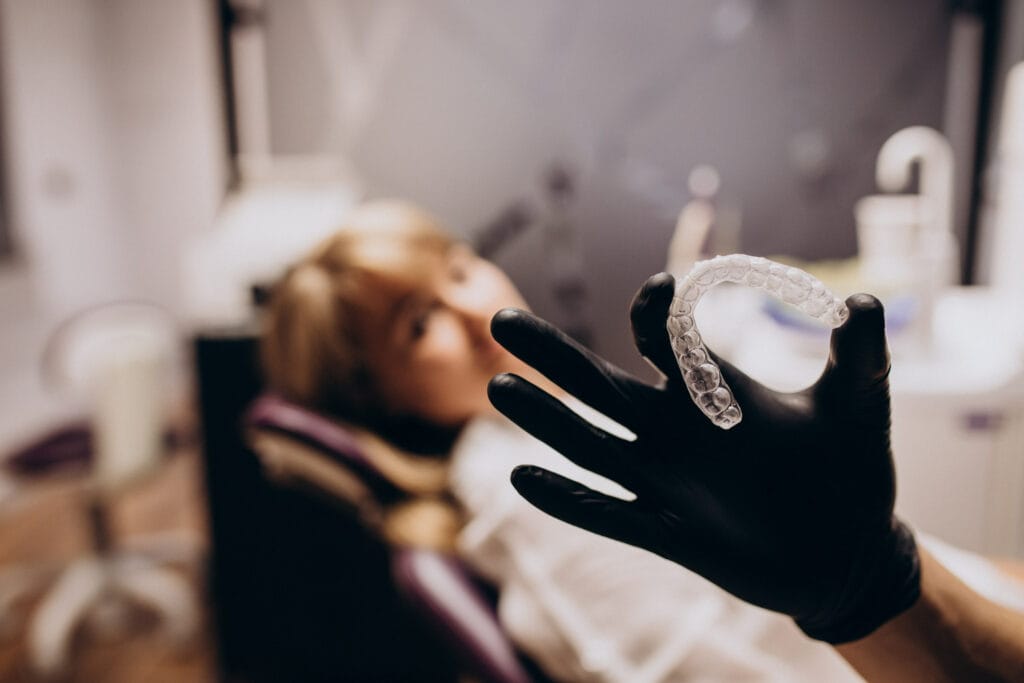
The consultation is quick. We scan your teeth, show you on the screen what aligners could do, and give you a price and a timeline. If you’ve been putting it off because you weren’t sure whether you needed the brand name, that’s an easy one: you don’t. Read more about SureSmile clear aligners at Mooring Dental, see what to expect at your first aligner visit, or request an appointment at our Clayton office. And if a straight smile is the goal, a lot of patients finish with professional whitening once the trays come off. It’s a nice way to end.
Questions patients ask about aligners and braces
Do you offer Invisalign at Mooring Dental?
We use SureSmile clear aligners, which work the same way as Invisalign: a 3D scan, a digital plan, and a series of clear trays. If you came in asking for Invisalign, SureSmile is the treatment we would put you in, and we will explain the differences before you decide.
Is SureSmile cheaper than Invisalign?
For a comparable case, SureSmile is generally priced lower because it does not carry the Invisalign brand premium. We give you an exact price for your case at the consultation, after the scan, so there is nothing to guess at.
How many hours a day do I have to wear the aligners?
About 20 to 22 hours. They come out to eat, to drink anything other than water, and to brush and floss, then go straight back in. Wearing them less slows the treatment down, which is the main thing to be honest with yourself about before choosing aligners over braces.
Can aligners fix an overbite or underbite?
Mild to moderate ones, often yes. Severe bite problems, teeth that need to move a long way vertically, or teeth that have not come in yet usually do better with braces or an orthodontist. We tell you which group you are in at the consultation.
Can I switch from braces to aligners partway through?
Sometimes. If the heavy lifting is done and what is left is fine-tuning, aligners can finish the job. It depends on what still needs to move, so bring your records and we will take a look.

About Mooring Dental
We’re a family dental practice at 304 Tew Court in Clayton, NC, led by Dr. Sean Mooring, DDS with associate Dr. H.M. Zombek. The office is open from 7:00 a.m. Monday, Tuesday and Thursday and from 8:00 a.m. Wednesday, and we keep same-day time for emergencies.
Read patient reviews · New patient information · Specials and membership plan
Straighter teeth, without guessing which option is right
Book a consultation at our Clayton office. We’ll scan your teeth, show you the plan, and give you an honest answer on aligners versus braces, with a price for your case.
Call 919-550-5611 Request an Appointment
Mooring Dental · 304 Tew Court, Clayton, NC 27520 · Mon, Tue, Thu 7:00 a.m. to 3:00 p.m. · Wed 8:00 a.m. to 4:00 p.m.